 Memory Tickets
Family travel
Family vacation memories: ideas kids will keep
Help kids keep family vacation memories with age-based jobs, a two-minute nightly routine, a shared handoff plan and keepsakes they help choose.
Help kids keep family vacation memories by giving each child one age-appropriate job: choose a photo, say a quote, keep a tally or make a short recap. Use the same two-minute routine each evening, then put every child's choices in one named place after the trip.
Ask a kid about last summer's vacation and you might hear about the hotel pool, an ice cream that fell on the ground or a dog on the beach. The famous view you drove two hours to see may not make the list. What they choose is the useful guide here, so the ideas below give children ownership while parents handle storage. For the adult side of remembering a trip, see how to remember your trips.
How do you help children remember a family vacation?
Give each child a small, regular way to keep their version of the trip, then record their words without polishing them. A photo they took, a paper item they chose or a sentence they said carries their point of view.
Keep each job short. A two-minute routine every evening lasts the whole vacation. A craft project lasts until the first rainy afternoon.
Copy this routine into the family trip note before leaving:
CHILD — PHOTO PICK — THEIR WORDS — PAPER TO KEEP — TOMORROW'S PICK
At dinner or bedtime, ask for each field once. A child may pass. If there are several kids, rotate who chooses "tomorrow's pick," such as the breakfast stop or one song for the car.
What can ages 3–6 do?
Young kids can't write much, but they can tell you about their day and point at what they like.
- Their quote of the day. At dinner or bedtime, ask one question: "What was the best thing today?" Write their answer down exactly as they say it, mistakes and all. Ten of these from one vacation are worth more than a hundred photos.
- They pick the photo. Scroll through the day's photos together and let them choose the one for the day. Their pick will often surprise you.
- One small paper item per day. A sugar packet, zoo map or postcard fits in a zip bag without becoming another suitcase. Do not treat leaves, rocks or shells as automatic souvenirs; rules depend on the place, and the National Park Service generally prohibits recreational collecting of park rocks and minerals. Photograph a natural find and leave it where it belongs when collection is not clearly allowed.
- Draw the day. A crayon drawing of "what we did" takes five minutes and goes straight into the album.
What can ages 7–11 keep themselves?
This is the age when kids like having a job and a thing of their own.
- Their own camera. An old phone in airplane mode, a cheap kids' camera or a disposable one. Agree on a small number of photos a day so they have to choose. They'll photograph things you didn't notice, from knee height.
- A notebook with one line a day. Give them a small notebook and ask for one sentence and one drawing each evening. Help with spelling only if they ask.
- A tally. Kids love counting: license plates from different states, boats, dogs, ice creams eaten. Keep the tally on the inside cover. Years later, it's a funny record of what mattered.
- A collection that grows. A pressed penny, a postcard or a patch from each place. Let them choose the kind of object, and keep it to one per stop.
- A Junior Ranger booklet or badge. The National Park Service says most of its sites have Junior Ranger programs, often using a free activity booklet and a visitor-center check-in. Look up the specific park before the trip because its directions and how it awards the badge can differ.
What can teens contribute without making it homework?
Teenagers usually have their own phone and their own photos. They don't need a craft. They need a reason to share what they'd keep anyway.
- Ask for their five photos. At the end of the trip, ask each teen for their five favorite photos from their own phone. Add them to the family album with their name in the caption.
- Let them make the video. A one-minute video of the trip, cut on their phone, with their choice of music. It'll be watched far more often than the full album.
- Put them in charge of the playlist. The songs from the car, the hotel, the beach. Name it after the trip and the year.
- One line, one photo, every night. Teens who won't keep a diary will often write one line under a photo. It's short enough to feel like a caption, not homework.
Ask before copying a teen's private photo, quote or video into a family album, and ask again before posting it. They can contribute to the family record without making every contribution public.
Which vacation memory ideas work for the whole family?
- The family photo in the same spot. Take one photo of everyone each day, or one each year in the same place if you go back. Ask someone else to take it, so the person who usually takes the photos is in one.
- Dinner question. One question per evening, everyone answers: "What was the funniest thing today?", "What would you skip?", "What should we do tomorrow?" Write down the answers. Our travel journal prompts have 60 more, and many work for kids if you ask them out loud.
- A shared album. One shared photo album for the trip, where everyone with a phone adds their best picks. Name it after the place and the year.
- A map on the fridge. Before the trip, put a map of the area on the fridge. After, mark everywhere you went, and let the kids add stickers or drawings.
- A postcard to the house. On the last day, each kid writes a postcard to themselves at home. It arrives after you do, with the last day still in it.
How do you keep everyone's photos and words together?
Choose one adult as the keeper before the trip ends. Everyone sends that person their final photo picks, videos and lines by a specific day; the keeper confirms receipt and puts them in a folder named with the place and year. This handoff matters more than choosing album colors because it prevents one child's part of the trip from staying on a phone that the rest of the family cannot access.
Inside the folder, make one subfolder per child and one called Whole Family. Keep names and dates in captions or filenames. If you make a physical album, preserve the same ownership by putting the child's name beside each choice.
- Make one small thing per kid. A few printed photos, their quotes, their collection and their drawings, in one envelope or a thin album with their name and the year. Our travel keepsake ideas have more on what to keep and how to store it.
- Read the quotes out loud at dinner a week after the trip. Then again a year later.
- Look back on the anniversary. Put a reminder in the calendar for a year after the first day, and look at the album together.
- Keep going at home. Kids who liked choosing the day's photo on vacation often like doing it at home too. Our guide to one photo a day covers how to keep it going.
How can one photo become a family vacation ticket?
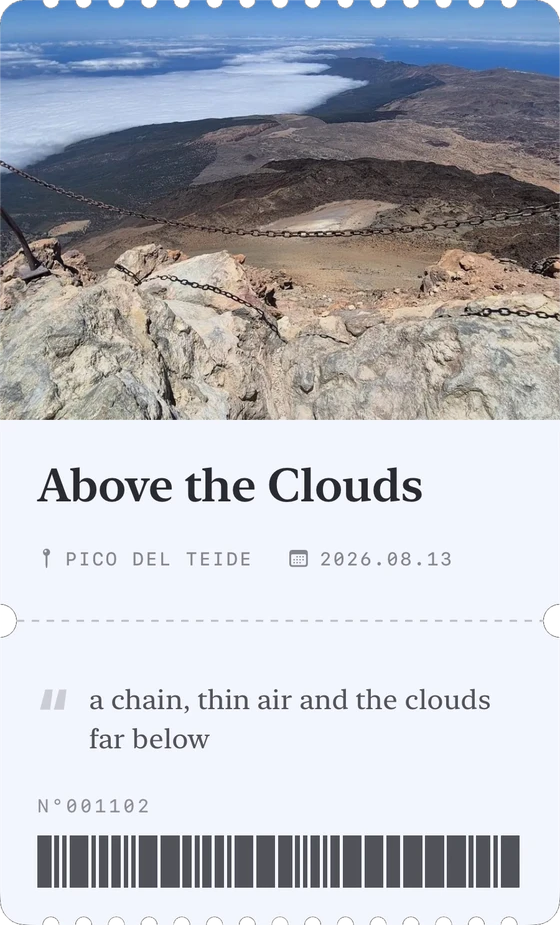
Memory Tickets turns one photo into a ticket with a title, place, date and one line, then collects the tickets by month. A child can choose the photo and dictate the line. It is free on iPhone, needs no account, works offline and keeps the photos on the phone.
Give every child one finished piece
End with something each child can recognize as theirs: an envelope, five-photo strip, one-page print or short video bearing their name and words. Keep the full family folder as the archive, but hand over the small finished piece first; it makes their contribution visible without turning the vacation into a documentation project.